Why Dieting Often Backfires: The Psychology and Biology Behind Weight Regain
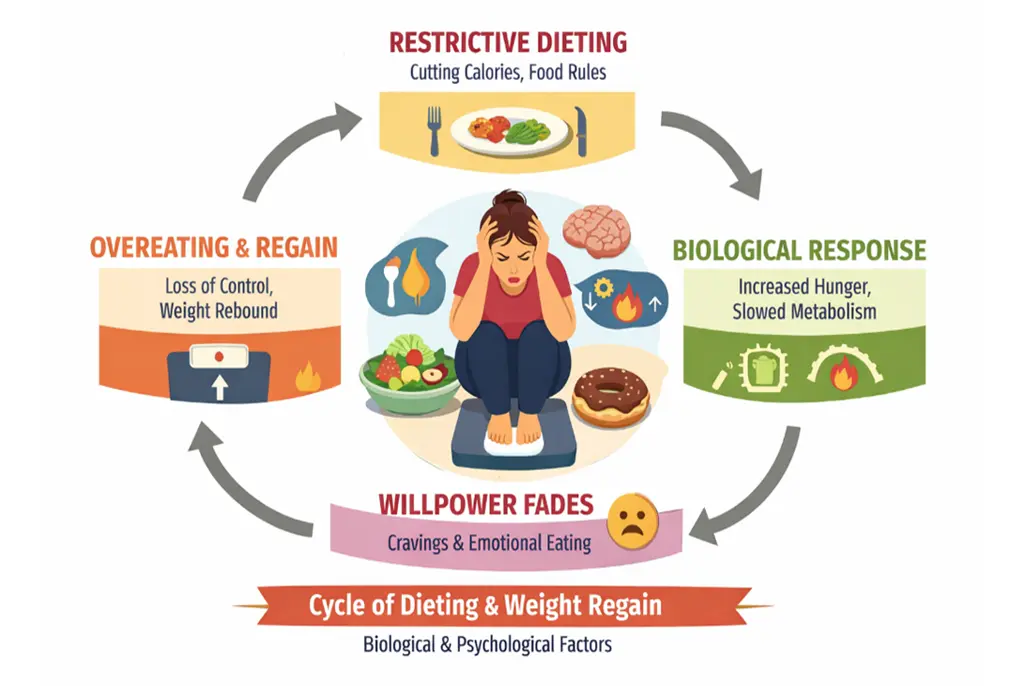
Many people struggle with repeated weight loss and regain, often feeling confused about why dieting doesn’t seem to work long term. Despite following strict meal plans or popular diets, the results rarely last. Understanding why weight loss and dieting often backfire means looking beyond willpower — and considering how our bodies, minds, and daily lives actually work.
Weight Loss Is Not Just About Willpower
Dieting often frames weight loss as a simple equation: eat less, move more. But the human body is far more complex than that.
When food intake is suddenly restricted, the body doesn’t register it as a lifestyle choice — it experiences it as a threat. In response, it adapts by:
- increasing hunger signals
- slowing metabolism
- conserving energy
- making food feel more mentally appealing
These responses aren’t flaws or failures. They’re protective mechanisms — designed to keep us alive, not to help us maintain a short-term diet.
The Psychological Cost of Dieting and Restriction
Beyond biology, dieting also shapes our relationship with food.
Labeling foods as “good” or “bad,” counting every calorie, or constantly feeling “on” or “off” a diet can gradually lead to:
- guilt after eating
- anxiety around meals
- loss of trust in hunger and fullness cues
- cycles of control followed by loss of control
Over time, eating stops feeling nourishing and starts feeling stressful — a common experience for people caught in cycles of restrictive dieting and weight regain.
For many people, rebuilding a healthier relationship with food requires support that addresses both emotional wellbeing and nutrition.
Life Doesn’t Pause for a Diet
Most diets assume ideal conditions:
- plenty of time
- low stress
- perfect routines
- consistent motivation
But real life is rarely ideal. It includes deadlines, family responsibilities, celebrations, fatigue, and emotional ups and downs.
When a plan can’t adapt to real life, it eventually stops working. And when that happens, people often blame themselves — instead of questioning whether the plan was realistic to begin with.
Our Role in Supporting Sustainable Change
At Wellbeing Psychology and Nutrition Center, we believe that weight and health are shaped by both psychology and nutrition — not willpower alone.
Our approach supports people in:
- understanding their eating patterns
- reducing guilt and all-or-nothing thinking
- building realistic, balanced habits
- improving wellbeing beyond the number on the scale
Because lasting health isn’t about fighting your body — it’s about learning to work with it.
Sustainable weight management is a journey — built on consistency, understanding, and support, not pressure or extreme rules.

COGNITIVE-BEHAVIORAL
THERAPY (CBT)
SOLUTION FOCUSED BRIEF
THERAPY (SFBT)
HYPNOTHERAPY
POSITIVE PYSCHOLOGY
(PERSONAL COACHING)
-
-
-
-
- PROJECTS
- ABOUT US
- SERVICES & PRICING
- FAQ
- PARTNER & MEDIA
- CLIENT SHARING
- BLOGS
Level 13, Wisma Mont Kiara, 1, Jalan Kiara, Mont Kiara 50480 Kuala Lumpur, Wilayah Persekutuan Kuala Lumpur
BRANCH
Level 1, Lot 63, Jalan Bukit Bintang, Bukit Bintang, 55100 Kuala Lumpur.
CONTACT US
call. whatsapp. +6017-9313116
email. general@wellbeingcenter.org
- NUTRITIONAL ASSESSMENT
- NUTRITION COUNSELING
- MEDICAL NUTRITION THERAPY (MNT)
• CORPORATE TRAINING (HRD CORP)
• PSYCHOLOGY AND NUTRITION EDUCATION WORKSHOP
.dsg by WONDERY